ISO 45003 and Workplace Mental Health: From Goodwill to a Managed Risk
Written by

ISO 45003 and Workplace Mental Health: From Goodwill to a Managed Risk
Depression and anxiety cost around 12 billion working days a year worldwide. Tunisia’s occupational medicine inspectorate puts psychosocial risk at 840,000 deaths a year and losses of 1.37 percent of world output. ISO 45003 is the standard that turns workplace mental health into a risk an employer can assess, treat and evidence.
HealthCare Innovation is the HealthTech cluster based in Monastir, Tunisia. We publish this because the subject arrives at companies as a wellbeing initiative and leaves as an audit question.
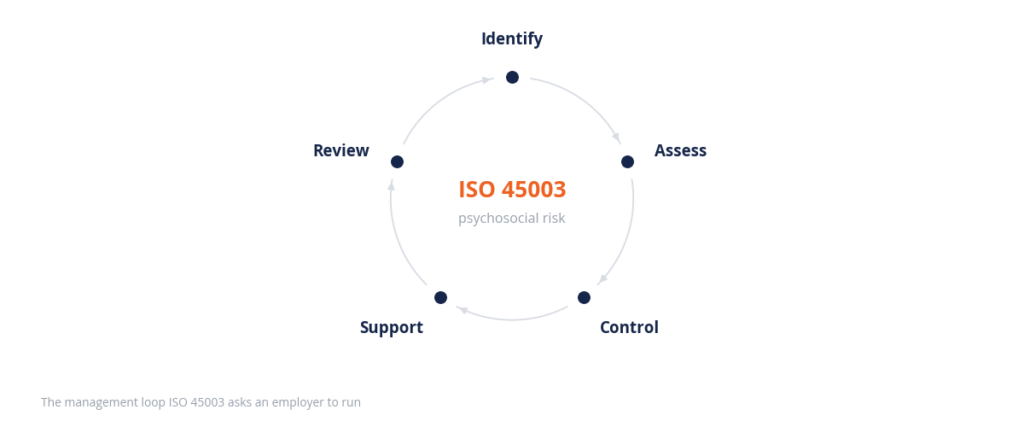
What ISO 45003 actually is ?
ISO 45003 was published in June 2021 . It is the first international standard devoted to managing psychosocial risk at work.
It sits inside an occupational health and safety management system built on ISO 45001. It applies to organisations of every size and sector.
One point is widely misread. ISO 45003 is guidance, so a company cannot be certified against it. What a company can do is use it to structure a risk assessment that an auditor, a client or a court can follow.
That distinction is the whole value. It moves the subject from intention to method.
The size of the problem
The World Health Organization sets out the global cost . Around 12 billion working days are lost each year to depression and anxiety, at an estimated 1 trillion dollars in lost productivity.
The joint guidance is more recent than most workplace policies. WHO and the International Labour Organization published guidelines on mental health at work in September 2022 .
Those guidelines recommend manager training for the first time. They also cover organisational measures, worker training, individual support, return to work and access to employment.
Read that list closely. Four of the six recommendations act on how work is organised. Only one acts on the individual.
What Tunisia already says ?
The subject is on the Tunisian agenda at official level. The World Day for Safety and Health at Work on 28 April 2026 was marked in Tunisia under a slogan calling for a healthy psychological and social working environment .
Lotfi Mahjoub, director general of the inspectorate of occupational medicine and professional safety at the Ministry of Social Affairs, set out the framework on national radio. Health and safety at work is a constitutional right. Declaring an accident or an occupational disease falls first to the employer, with the national health insurance fund. The employee may declare it if the employer does not.
He also gave the compensation scale.
| Incapacity rate | Compensation |
| Below 5 percent | None |
| 6 to 15 percent | Lump sum |
| Above 15 percent | Life annuity |
Now put those two facts side by side. The inspectorate placed psychosocial risk at the centre of 2026. The compensation scale opens at a measured incapacity of 5 percent.
A psychosocial injury rarely produces a rate at that level. The architecture is calibrated on physical impairment. This is our reading of two published facts rather than a legal opinion, and it should be checked with a lawyer before anyone relies on it.
The practical consequence is simple. Where compensation is hard to reach, prevention is the only mechanism that changes anything.
« An employer who waits for a psychosocial injury to be compensated will wait a long time. Prevention is not the generous option here. It is the only one that works. » Dr Haroun Ouanes, Director, HealthCare Innovation
Why the reporting chain reaches Tunisian companies
European sustainability reporting changed this year. The Omnibus directive, Directive (EU) 2026/470, was published in the Official Journal on 26 February 2026 and entered into force on 18 March 2026.
It narrows the scope. Reporting under the European sustainability standards now applies to entities above 1,000 employees and 450 million euros of net turnover. Listed medium and small companies leave the scope. Member States have until 19 March 2027 to transpose the changes.
Inside those standards, ESRS S1 covers a company’s own workforce and applies where that topic is material. Workers in the value chain fall under ESRS S2.
So fewer European companies report. That is where most commentary stops, and it misses what happens next.
Supplier questionnaires are a procurement instrument, not a legal one. A European client that still reports will keep asking its suppliers about working conditions, and a client that no longer reports often keeps the questionnaire it already built. A Tunisian exporter can therefore receive the question either way. This is a reading of how procurement behaves rather than a rule written anywhere.
Health and safety data is the part of that questionnaire a company can prepare in advance.
What an employer can put in place in ninety days ?
None of the following requires certification, a consultant or a licence.
- Name the hazards. Workload, deadlines, isolation, unclear roles, hostile behaviour. Write the list for your own company, not a generic one.
- Assess them like any other risk. Likelihood, severity, exposed population. Use the same register as physical risks, on the same page.
- Train the managers. WHO recommends it explicitly. A manager who recognises distress early changes the outcome more than any application.
- Fix the organisational causes you control. Shift patterns, notice periods, on-call rules, how work arrives. These are the four of six recommendations that act on the organisation.
- Record what you did and what changed. That record is the answer to a client questionnaire and the beginning of a real prevention programme.
Where digital tools help, and where they do not
Tools measure. They rarely repair. We set out five barriers to adoption in AI and workplace wellbeing , and the first of them is trust.
A survey that reaches an employer without protecting the respondent produces silence rather than data. A tool sold to the employee adds to what households already pay directly, a trap we describe in Tunisia’s health financing gap .
The useful place for a digital tool is narrow and real. It can track exposure, run an anonymous assessment at scale, and hold the evidence trail. Prevention itself is a management decision.
That is also where an insurer becomes interested, because reduced absence shows up in claims. We look at that logic in Health insurance in the Maghreb .
Companies working on occupational health can reach us through Proovlab and the Community page
Frequently Asked Questions
Q: What is ISO 45003?
A: The first international standard on managing psychosocial risk at work, published in June 2021. It gives guidance inside an occupational health and safety system based on ISO 45001.
Q: Can a company be certified to ISO 45003?
A: No. It is a guidance standard. A company can be certified to ISO 45001 and use ISO 45003 to structure the psychosocial part of its risk assessment.
Q: What does poor workplace mental health cost?
A: Around 12 billion working days a year worldwide to depression and anxiety, at an estimated 1 trillion dollars in lost productivity, according to the World Health Organization.
Q: Does Tunisia compensate psychosocial injury?
A: The compensation scale opens at 5 percent measured incapacity, with a lump sum from 6 to 15 percent and a life annuity above that. Reaching that threshold for a psychosocial injury is difficult, which is our reading rather than a legal position.
Q: Does European reporting still affect Tunisian suppliers?
A: Fewer European companies report after Directive (EU) 2026/470. Supplier questionnaires come from procurement rather than from the directive, so the question can still arrive.
HCI Resources
Accelerating Innovation in HealthTech
Pharma & Medical Device Regulatory Services
External Citations
International Organization for Standardization – ISO 45003:2021, psychological health and safety at work
World Health Organization – mental health at work fact sheet
World Health Organization and International Labour Organization – guidelines on mental health at work (2022)
La Presse de Tunisie – occupational accidents, rights, figures and thresholds (2026) :
Official Journal of the European Union – Directive (EU) 2026/470, sustainability omnibus