Collaboration Perspectives between the Healthcare Sector and Startups: Towards a New Medical Era
Written by

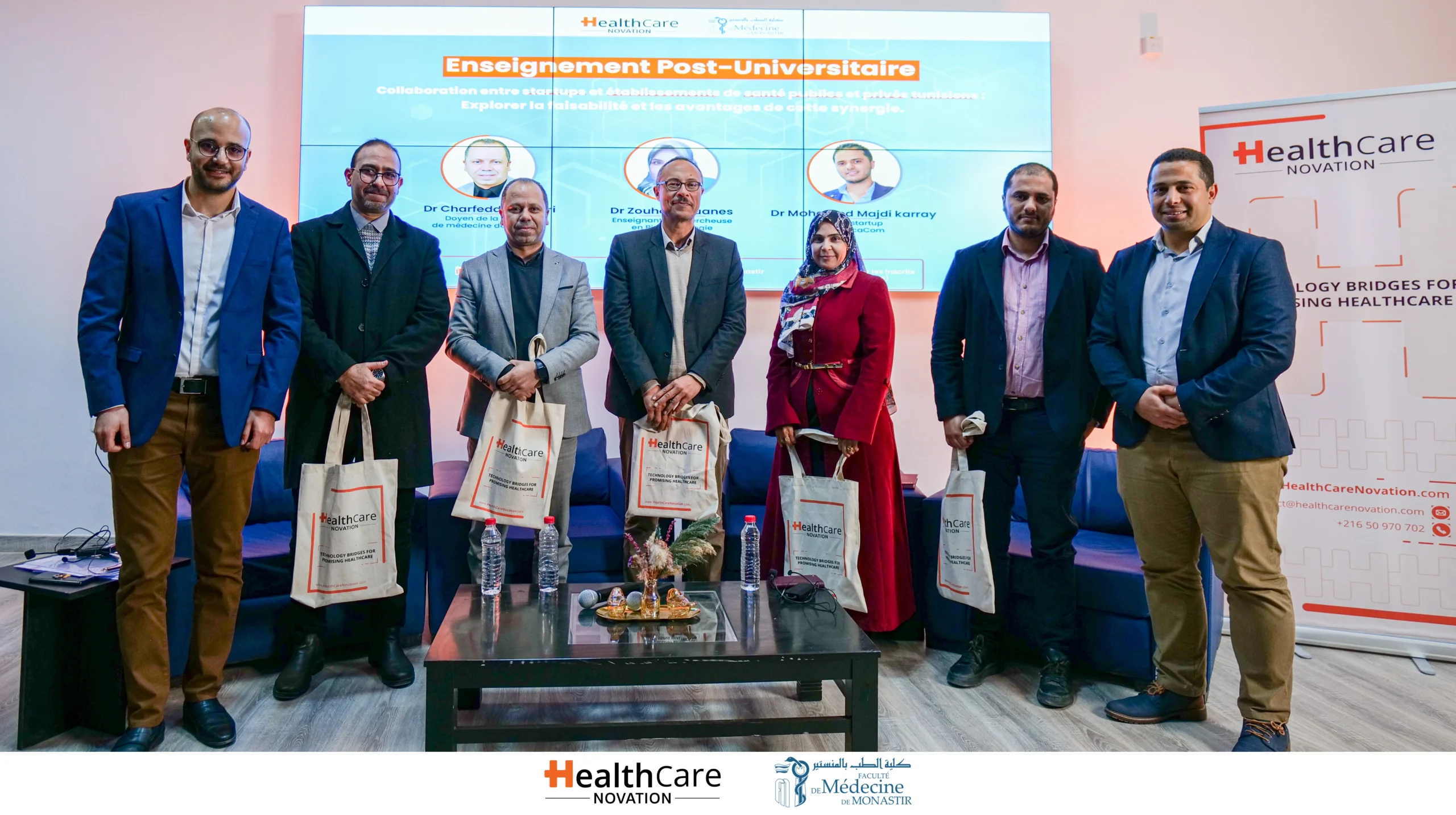
How can hospitals, universities, and startups collaborate effectively? The Faculty of Medicine of Monastir (FMM) and HealthCare Innovation (HCI) convened a high-level panel to turn lessons from practice into a playbook for Tunisia’s HealthTech ecosystem.
This article distills the session’s insights into clear steps: building applied research pipelines, validating innovations through Smart Lab, navigating PPP frameworks, and accelerating adoption in clinical settings.
Context & Participants
The first postgraduate session (3 February 2024) gathered 120+ participants from university hospitals in Monastir, Sousse, Mahdia, and Nabeul, alongside entrepreneurs and administrators. Speakers included: Prof. Charfeddine Amri (Dean, FMM & Smart Lab Director), Dr. Zouhour Ouanes (Assistant Professor, ISBM), Dr. Mohamed Majdi Karray (Founder, MedicaCom), and Mr. Slaheddine Dardouri (Moderator).
Why This Matters
HealthTech adoption is often slowed by fragmented collaboration and unclear validation pathways. According to the OECD, digital health ventures face significant scale-up frictions, while the WHO Global Strategy on Digital Health highlights the need for governance, workforce skills, and interoperability.
From Panel Insights to Actionable Steps
1) Build Applied-Research Pipelines (Universities × Hospitals × Startups):
- Prioritize problem-driven research and strengthen tech infrastructure across academic health institutions.
- Embed continuous training for clinicians in digital tools and data practices.
- Use engineering final-year projects and clinical needs as joint scoping exercises for prototypes.
2) Validate Early via Smart Lab (Compliance & Risk Reduction):
- Leverage FMM’s Smart Lab as an R&D, verification, and medico-legal risk mitigation platform.
- Target ISO 17025-grade testing where relevant to generate credible validation reports for startups.
3) Start Small, Deliver Fast (Time-to-Value):
- Prioritize short-cycle pilots that solve specific ward-level problems before scaling.
- Apply lightweight project management for needs assessment, scope, and evaluation.
4) Co-Design Education (Reverse Engineering & Joint Courses):
- Adopt reverse engineering in academic projects to align curricula with clinical realities.
- Co-construct training with universities and industry to bridge skills and deployment.
5) Track Funding & Open Calls (Incubation/Acceleration):
- Monitor calls for projects and incubation/acceleration programs to build networks and finance pilots.
6) Secure the Regulatory & PPP Framework:
- Activate public–private partnership mechanisms to formalize hospital–startup collaboration.
- Consider transitions from EPNA to EPST status where appropriate to align institutional missions with innovation.
- Publish innovation outputs to protect IP through copyright and ensure knowledge diffusion.
- Apply Decree No. 2001-1182 to channel university-generated revenues into innovation and applied research.
Benefits for Clinicians, Students, and Startups
- Clinicians: faster access to validated solutions, reduced medico-legal risk via structured validation (e.g., ISO 17025 contexts).
- Students: hands-on experience with real clinical problems, stronger employability in HealthTech.
- Startups: credible validation pathways, clearer hospital collaboration models, and quicker time-to-market.
Internal Links (HCI Resources)
Accelerating Innovation in HealthTech → https://healthcareinnovation.tn/accelerating-innovation-in-healthtech/
HCI Startup Programs → https://healthcareinnovation.tn/service/startups/
Pharma & Medical Device Regulatory Services → https://healthcareinnovation.tn/service/pharma-medical-device/
HCI Experts Network → https://healthcareinnovation.tn/experts/
HCI Community → https://healthcareinnovation.tn/community/
External Citations
OECD — Digital health overview: https://www.oecd.org/health/digital-health.htm
WHO — Global Strategy on Digital Health (2020–2025): https://www.who.int/publications/i/item/9789240068891
FAQ
Q: How can startups work with hospitals without long delays?
A: Start with short pilots that address a specific clinical need, use Smart Lab-style validation, and document outcomes for scale-up.
Q: How can universities contribute to faster innovation cycles?
A: Align curricula with clinical needs via reverse engineering, co-design courses with industry, and mobilize final-year projects toward real problems.
Q: What legal tools support collaboration?
A: PPP instruments, potential EPNA→EPST transitions, IP via publication, and revenue allocation under Decree 2001-1182.
Q: Where can I find support?
A: Engage with HCI’s Startup Programs, the HCI Experts Network, and HCI Regulatory Services.
Partner with HealthCare Innovation (HCI) to co-design pilots with hospitals and accelerate compliant market entry: Explore HCI services
Author & Footer
By HealthCare Innovation (HCI) Editorial Team. HCI is Tunisia’s HealthTech cluster connecting startups, clinicians, and partners across the Euro-Med region.